
THE LIFE AND TIMES OF SOLOMON NXASANA
1865-1951
Solomon Nxasana was born in 1865 to Magxala and MaSogoni in the Qumbu area. Magxala had two sons, Soli and Mabhongo. Magxala died when Soli was very young and MaSogoni single-handedly raised her two boys. Elders tell us that Magxala is buried somewhere in Qumbu. There were already Methodist missionaries in the Qumbu area during this time. She made sure that her sons adopted Christianity and were educated.
Soli joined the Methodist missionaries and rose to the rank of “Umshumayeli wase-Weseli”. He acquired many skills under the Wesleyan missionaries including the principles of commercial enterprise, as well as building and construction skills. He started his own business in transportation and building construction and prospered.
Soli and Mabhongo must have known that their roots were in Creighton, KwaCekwana. KwaCekwana (Creighton) is still one of the most beautiful areas in South Africa today. Creighton was described by Piet Uys, the leader of the Kommissie Boer Trek in 1834 when he said “Only heaven can be more beautiful”. As an entrepreneur, it was natural that Soli would go back to the land of his forefathers.
It was through the missionaries and the wealth and capital that he had accumulated that he migrated from Qumbu to Creighton. Because of the laws under the “Shepstone System” and the fact that Soli was educated and “UmShumayeli wase-Weseli”, he applied and was granted an “exempted native” status. When he arrived in Creighton, Soli bought a farm KwaCekwana. His home is said to have been where the Creighton Railway station is today. Soli got married to Rhoda Shezi (MaShezi) in 1890 when he was 25 years old. Thithiza Shezi (MaShezi’s father) was also an “exempted native” as well as an entrepreneur and owned a farm in Creighton.
In 1891 Soli and other Nxasanas were moved from Creighton to KwaNcakubana. Whilst the other Nxasanas bought farms at Mahehle, Soli felt it was too cold and bought Farm Lot BM Number 7760 in kwaNcakubana. The farm was 39.0396 hectares (99 Acres, 2 Roods, 2 Perches situated in the County of Pietermaritzburg, in the Colony of Natal). From the title deed, the survey certificate of the farm which had been surveyed by a Mr H Walker, a Sworn Land Surveyor was issued a year after Soli had acquired the farm in February 1892. The farm is described as “bounded northeastward by Lot BN, eastward by the Incugubaan stream, southwestward by Lot BL, westward by “Islington No II”
In 1910, the Union of South Africa was formed which stripped the Africans of most of the rights which they had been given under the “Shepstone System”, including the franchise to vote for the “exempted natives”.
In 1911, Soli bought an adjoining farm, Lot BNA 7918 which was also 39.0396 hectares (96 acres, 1 rood, 35 perches) This farm had been surveyed by Mr H Walker in June 1895. The farm is described as “bounded westwards by lots S74, S75, S76, S77, &S78-Southwards by Lot BM, Eastwards by the Incugubaan stream, and Northwards by the remainder of Lot BN”.
In 1913 the Native Land Act was promulgated which dispossessed black people of their land which was transferred to white hands. It was at this time that black people we removed from fertile land into “native settlements” or “locations” or as they were called, “kwanokhesheni”. Parts of kwaNcakubana and Mahehle which were not owned by any “exempted native” were declared a location for settlement of Africans who were moved from areas where they had to give way for white farmers.
Ncakubana is situated along the road from Creighton to Umzimkhulu. The Nxasana farm slopes from west to east, and borders Mahehle on the west. The farm also has a stream of water which runs all year with its source from the little “koppie” on the western side behind the Nxasana homestead. This also made the farm attractive for Soli. Mahehle is situated on top of the Ncakubana “koppie” on the west and overlooks Creighton.
Soli was an entrepreneur “par excellence”. He started a transportation business with ox-wagons and a building construction business. Delagoa Bay was the main port for goods imported into South Africa from the 1800s to the 1920s. Soli would transport goods from Delagoa Bay to Durban as well as Johannesburg.
The main house at the Nxasana homestead in KwaNcakubana was built by him as soon as he moved to KwaNcakubana. As can be seen even today, the home was built with stone which made it structurally very sound. He was a skilled stone mason, judging by the quality of workmanship in the construction of the house. He worked very closely with his son Majavu in the transport and construction business.
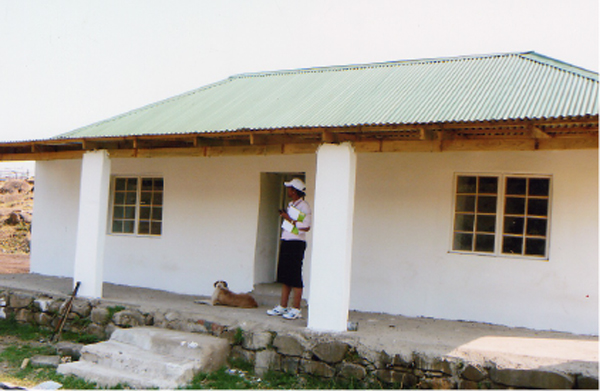
Nxasana homestead in KwaNcakubana
He was also a farmer of note, and farmed livestock, sheep and chicken, mainly because the land in KwaNcakubana was not arable for grain cultivation.
Soli was blessed with a son, Majavu, prior to getting married to MaShezi. Soli and MaShezi gave birth to nine children, Sarah Nganyana born in 1891, Etclot “Nyembezi” born in 1893, Gidward born in 1895, Makethe born in 1897, Asiena born in 1899, King born in 1901, Vunina born in 1903, Ballance born in 1905 and Holon (Rholomu) born in 1907.
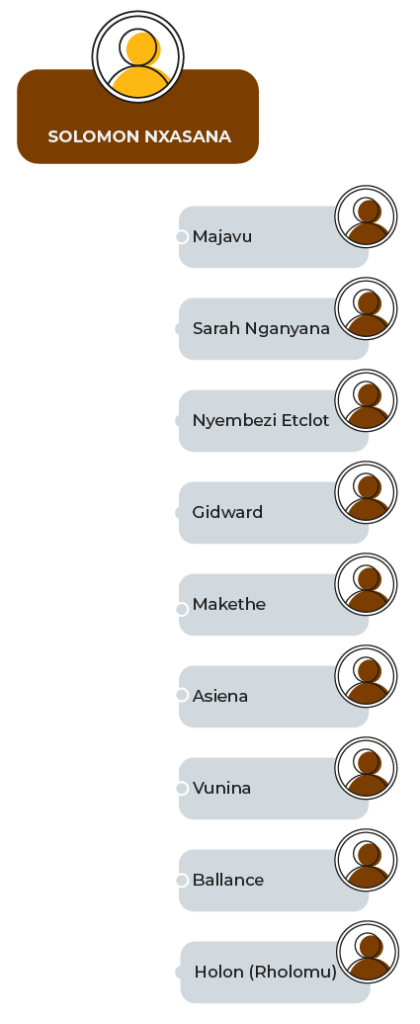
Solomon’s direct descendants
His brother Mabhongo had five children, Lanti, Gibber, Nomemo, Emmy, and S’dobhi.
Education was very important to Soli, and he wanted the best education available at the time for his children. He would later sell part of his livestock and assets to fund their education.
Majavu
Soli was later to be joined by Majavu in the building construction business. Soli liked Majavu’s high work ethic and was also very impressed by his building skills. They built a number of houses with Majavu in the Exobho area. Majavu’s diligence enabled him to have more cattle than most of the locals.
Majavu died in 1942.
Nganyana
Nganyana grew up kwaNcakubana and was blessed with two daughters, Bathini and Mantombi
Nyembezi
The culture at the time was paternalistic and Nyembezi, as the eldest son in wedlock, was regarded as the guardian (indlalifa) of Soli’s family. He went to Amanzimtoti College (Adams College) south of Durban and thereafter trained as a health inspector. After finishing school, he got married to Lydia Ngcobo (MaNyuswa) and settled in Durban in the Clare Estate, Overport and Point Road areas before relocating to Lamontville in 1936. Lamontville was started as a township for the black middle class in 1934. It was initially called “Lamont Village”
Nyembezi grew up believing that being “indlalifa” meant that he was to inherit all the assets and wealth which Soli had accumulated. His was a shrewd person who drew very clear lines between people he “liked” or “disliked” for whatever reason. He did not seem to get on well with some of his brothers or other members of the family who he saw as a threat to his inheritance of Soli’s estate.
Nyembezi and MaNyuswa were blessed with three children, Ntombende Muriel, Dukes, Fortesque Sifiso and Ntombizandile.
Nyembezi, like Soli was very passionate about education and ensured that his children got the best education.
On the advice of Soli, Nyembezi acquired the adjoining farm Lot BL7379 which is 40.5745 hectares ( 230 Acres, 1 Rood, 17 Perches. The property is described as “bounded northeastwards by Lot BM (7760), Eastwards by Incugubaan stream, Southwestwards by Lot BI, Westwards by Islington NOII).
Because of Nyembezi’s interest in education, he “donated” three acres of this property for the construction of Ncakubana Combined Primary School which benefits the community of Ncakubana.
He died in 1987 at the age of 94.
Gidward
Gidward like Nyembezi, went to Amanzimtoti College. He got married to MaMhlongo and they settled in Orlando, Soweto in Johannesburg. Gidward worked at Simmer and Jack mines for many years as a clerk. Later, he joined Johannesburg General Hospital as a clerk.
Gidward was also an entrepreneur and traded in horses from his Orlando home which were very popular with AmaBhaca who worked in Johannesburg from KwaZulu Natal, as well as Soweto coal merchants.
He died on the 6th of October 1975 at the age of 80.
Makethe
Makethe was born in 1897. He also went to Amanzimtoti College briefly. He went back to kwaNcakubana where he joined Soli on the farm. He got married to MaNdadane who came from Harding. They were blessed with five children Njinga, Bachithile, Bhekumndeni (Gemfu) and Nombuyiselo.
He died in 1937 when he drowned whilst riding a horse across a flooded Ncakubana river.
Asiena
Asiena was born in 1899 KwaNcakubana.
She got married to Chiliza.
King
King was born in 1901. In line with the family tradition, he went to Amanzimtoti College. He was offered a bursary to go and study medicine in London, UK but Soli advised him against it because he was worried that King would be too far from the rest of the family. He then proceeded to Marianhill Teachers’ Training College (otherwise known as St Francis College) outside Pinetown.
He got married to Harriet MaGebashe and they were blessed with six children Simphiwe, Mthuthuzeli, Mnyamezeli, Sanele, Bhekisisa and Nomathamsanqa.
He started to work as a school teacher at Centocow Mission, a Roman Catholic School in Creighton. He then followed his brother Gidward to Johannesburg and also worked for Simmer and Jack mines as a clerk. He then moved to Durban and joined The Natal Mercury as a newspaper typesetter.
He was killed in 1949 whilst walking with his nephew German Nxasana to a nearby shop during the Zulu/Indian clashes.
Vunina
Vunina was born in 1903. She went to school at Marianhill College and then proceeded to Marianhill Teachers’ Training College.
She taught briefly before she got married to Reverend JC Mvusi who was later to be appointed as the President of the Methodist Church.
She died in 1975 at the age of 72.
Ballance
Balance was born in 1905. He went to Amanzimtoti College. He got married to MaMntaka. Later, he got married to Nthina Lepule. He worked for Springs Mines as a mine clerk and lived in Springs on the East Rand. He was blessed with three children Kuli, Fanyana and Russia.
Holon (Rholomu)
Holon was born in 1907. He was educated at Amanzimtoti College. He got married to Harriet Radebe and they were blessed with one son, Hodges.
He worked at Clover Dairies in Durban as a clerk.
The Death of Our Icon
In the early 1930s MaShezi took ill and later died. Soli then got married to MaGabela, Nomampondo Evelyn Nxasana. MaGabela was blessed with three children, daughter Senzeni, son Gospel “Maguduva” and daughter Noziyalo.
Soli had a firm belief in the virtues of a strong family. From the letters he wrote to Nyembezi, it was clear that he wanted unity in the family. He believed the family had to remain a strong unit. He was interested in his family being together and sharing in the wealth that he had created, and as they got educated, growing the family’s wealth and assets further for the benefit of future generations. It is in this regard that he always used to say “Kwanga akusabuye kubekho iinkedama ozalweni lwami”. He allowed all his children to build homes on the farm.
He was clearly disappointed that Nyembezi was very individualistic and not inclusive as “indlalifa”. He was also very concerned that Nyembezi did not have a good relationship with some of his brothers and seemed not interested in uniting the family.
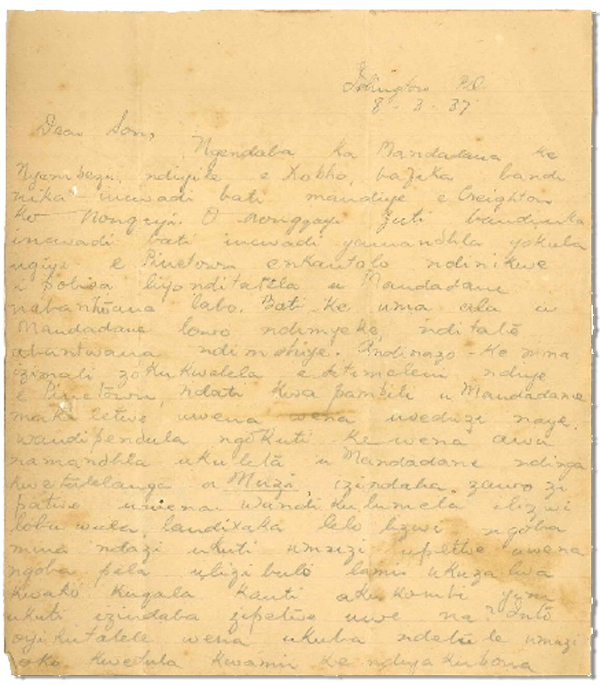
Soli’s letter to Nyembezi Nxasana- 8 March 1937
The adjoining farms which belonged to Bhememe Shezi and related to his in-laws, as well as another smaller farm which belonged to MaMkhize had become available for sale. In his letter to Nyembezi dated 25th of March, he informed him when the date of the sale was going to take place and asked him to purchase those farms as security for the future and an investment for future generations.